






Updated
Key takeaways
- A fractional architect owns four things part time: the target architecture, review gates, a sequenced roadmap, and the standards your team builds against.
- The model fits three moments: the program between builds, before an Agentforce rollout, and after a rescue.
- Independent review requires a separate review role; a fractional contract alone does not remove delivery conflicts.
- It does not replace delivery capacity or a daily full-time architect at high change volume, and it fails without real gate authority.
A fractional Salesforce architect is a senior architect who works with your organization part time, on a recurring basis, to own design decisions, review gates, and the technical roadmap without joining as a full-time employee. You get architect-level judgment for a few days a month without committing to a permanent role. Availability and the scope of decision ownership are agreed before the engagement starts.
The term shows up more often now because the market has caught the gap. Teams can staff admins and developers quickly. The seat that stays empty is the one that decides whether a data model scales, whether a sharing design holds at volume, and whether the next build becomes an asset or a liability. This piece explains what the role covers, the three moments it fits, how it compares to the alternatives, and where it falls short.
What is a fractional Salesforce architect?
A fractional Salesforce architect is an experienced architect engaged part time to hold design authority for your org. They set patterns, review work before it ships, and steer the roadmap. They carry the judgment of someone who has delivered across many orgs, applied to yours, without the cost or commitment of a permanent hire.
The word “fractional” describes the time commitment, not the seniority. A fractional architect is not a junior resource stretched thin. The model works precisely because the person is senior enough that a few structured days a month move more risk off the table than a full-time mid-level hire would in a full week. In our advisory work across EU enterprises, the recurring pattern is the same: the decisions that shape an org for years take hours to make and years to unwind. Those hours are what you are buying.
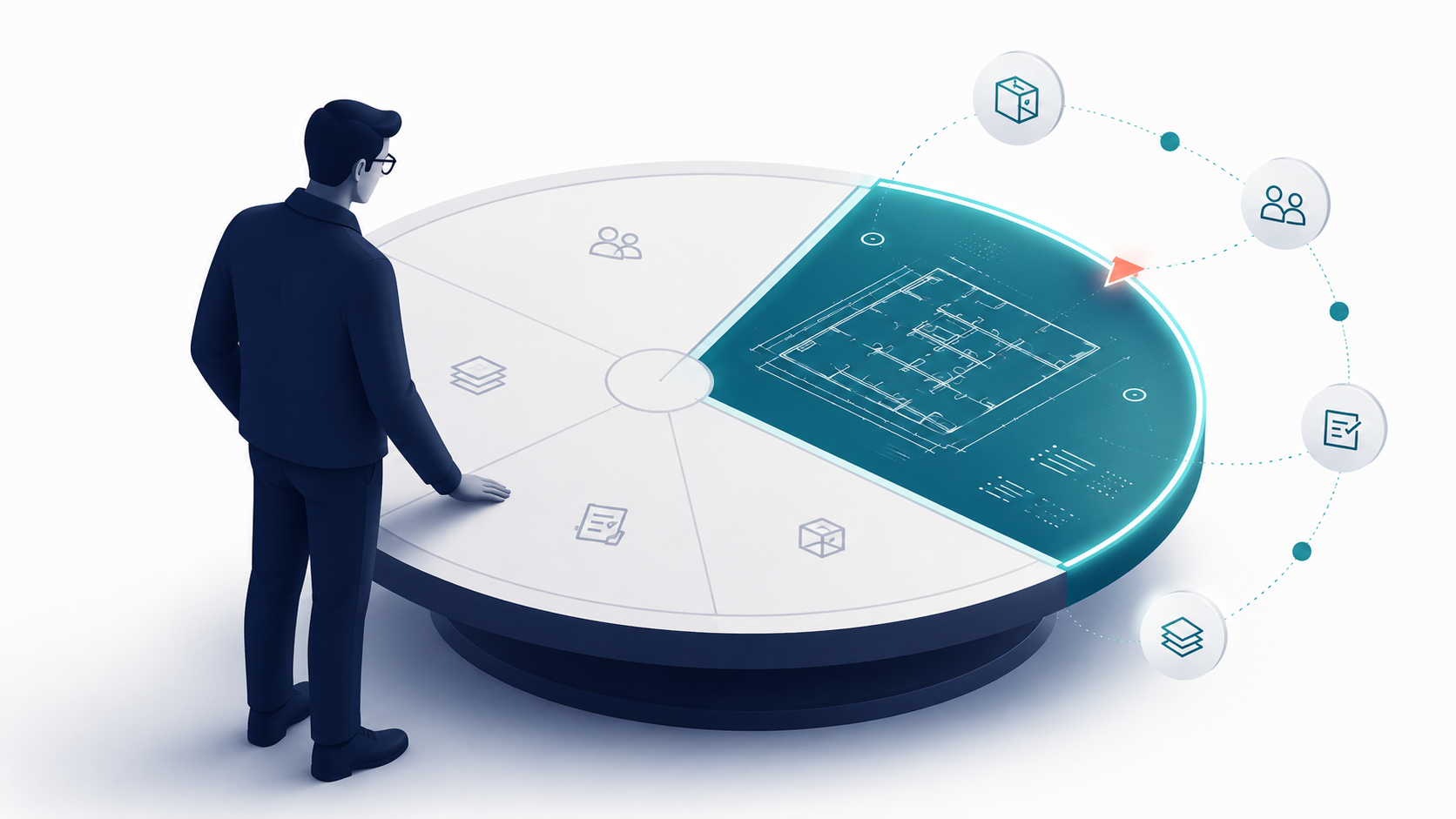
A fractional architect typically owns four things: the target architecture (data model, sharing model, integration boundaries), the review gates that protect it, the technical roadmap that sequences work, and the standards your internal admins and developers build against. They rarely write the day-to-day configuration themselves. They make sure the people who do are building the right thing.
When does a fractional Salesforce architect beat a full-time hire?
Three moments make the fractional model the better call. Each one shares a trait: you need architect-level decisions continuously, but not architect-level headcount every day.
The program between builds
Your org is live and evolving. Admins ship changes, a partner delivers a project here and there, and no single person holds the whole picture. This is where drift starts: a flow duplicating a validation rule, a one-off field that becomes three integrations’ source of truth, a sharing exception that quietly breaks least-privilege. A fractional architect holds the map between builds, so each change lands inside a coherent design instead of next to it. If you want a snapshot of where that drift already sits, a focused architecture review is often the entry point.
Before an Agentforce rollout
Agents fail on weak grounding data far more often than on model choice. Before an Agentforce rollout, someone has to decide what data the agent can trust, which objects it reads, and where the guardrails sit. Our data quality app, Data Quality Sense, detects and reports field-level issues through batch scans; it does not auto-fix or merge records. So an architect still has to decide what to remediate, in what order, and what “good enough to ground an agent” means for your use case. That decision sits above any tool.
After a rescue
A project went sideways. You have stabilized it, and now the question is how to rebuild without repeating the pattern that caused the failure. Bringing a full-time architect in at this moment is slow, and the person you hire under pressure is rarely the person you would choose with time. A fractional architect gives you senior oversight immediately, then hands more to your team as confidence returns.
Fractional architect vs full-time hire vs SI?

A fractional architect provides senior design authority on an agreed cadence. A full-time hire provides daily presence; an integrator provides delivery capacity. Relevant experience and review independence depend on the people and responsibilities you appoint, not on the contract label.
The dimensions that actually separate the three options are cost structure, availability, how many orgs the person has seen, and whether the reviewer has an incentive to approve their own work. That last one, conflict of interest, is the dimension most buyers underweight and later regret.
| Dimension | Fractional architect | Full-time architect hire | Systems integrator |
|---|---|---|---|
| Cost structure | Days per month, scalable up or down | Full salary, benefits, ramp | Project fee, tied to scope |
| Time to value | Days | Weeks to months (hiring + ramp) | Weeks (SOW + staffing) |
| Availability | Scheduled cadence, not on demand | Daily, embedded | For the length of the engagement |
| Breadth of pattern exposure | High (many orgs, verticals) | Narrow (one org over time) | Broad, but delivery-focused |
| Review independence | Define separation from delivery work | Agree review ownership for their own designs | Ask how delivery decisions are independently challenged |
| Continuity | Persists across builds and vendors | High while employed | Ends with the SOW |
| Best when | You need judgment, not headcount | Change volume needs a daily owner | You need hands to build |
Read the table as a fit test, not a scoreboard. If your change volume genuinely needs an architect in the room every day, hire one. If you need people to build a defined scope, engage an SI. The fractional model wins the middle: continuous design authority, independent of who is building, at a cost that matches how often you actually need the decision made.
What a good fractional cadence looks like
The model lives or dies on rhythm. A fractional architect sits alongside your team, not in front of it. The goal is design authority that guides work without becoming an approval bottleneck. Three mechanics make that real.
A standing design authority. A recurring session where in-flight decisions get made with the architect present: the new object versus a field on an existing one, the flow versus the Apex trigger, the integration pattern for the next system. Decisions get recorded with their rationale, so the reasoning survives after the session ends.
Review gates, not rubber stamps. Work passes an architecture gate before it merges: data model changes, sharing changes, anything touching integration boundaries or governor-limit-sensitive Apex. The gate exists to catch the expensive-to-reverse choices, not to slow the small ones. A good fractional architect is explicit about which changes need a gate and which your team owns outright.
A living roadmap. The architect keeps a sequenced view of what is coming, what depends on what, and where technical debt has to be paid before the next build sits on top of it. This is the artifact that makes the engagement compounding rather than reactive.
Architect-led is the default on every Tucario engagement, and the CTA credential behind it (one of fewer than 500 worldwide) is what lets a few days a month carry this weight. Breadth matters here too: pattern exposure across 50+ enterprise engagements and seven industry verticals is what turns “I have seen this fail before” into a design decision you make in an afternoon.
What should you agree before appointing a fractional architect?
Write down the decisions the architect can make, the decisions they recommend to your leadership team, and the work that remains with the implementation partner. A title alone does not establish authority.
| Agreement | What to record |
|---|---|
| Decision ownership | Named approver for architecture, business scope and budget |
| Review cadence | Planned design sessions, preparation and release checkpoints |
| Availability | Working-hour overlap for US and European stakeholders, response expectations and escalation route |
| Evidence | Decision log, current diagrams, unresolved risks and the owner of each next action |
| Delivery boundary | Who builds, who reviews, and how disagreements are resolved |
| Continuity | Where records live and how the role is handed over or ended |
Use the first meeting to test a real pending decision. Ask what information is missing, which options deserve consideration and who must approve the result. That gives you a more useful basis for scoping than an undefined number of architect days.
What a fractional architect can’t replace
Be honest about the limits, because the wrong fit wastes everyone’s time.
A fractional architect does not replace delivery capacity. If you have no admins and no developers, an architect with no one to hand decisions to is an expensive advisor with nothing to advise. You need hands before you need design authority over the hands.
It does not replace a full-time architect when change volume is genuinely daily. Some orgs, usually large ones running multiple parallel programs, need an architect present every day to keep pace. At that scale, hire, and use a fractional engagement only to bridge the gap until the seat is filled.
It does not work without organizational buy-in. Review gates need teeth. If leadership treats the architect’s design authority as optional, the drift the model exists to prevent comes back through the side door. The engagement works when the architect’s gate is a real gate.
If none of the three moments describe you, and your org is small, stable, and served well by standard configuration, you may not need a fractional architect at all. That is a fine place to be. The model earns its keep when the cost of a wrong architectural decision is high and the frequency of those decisions is steady.
When the fit is right, the next step is a conversation about cadence and scope, not a signed retainer. Our Salesforce Strategy & Architecture Advisory engagement is built around exactly this rhythm, and it often starts with a single architecture review so both sides see the real state of the org before committing to a cadence.
To make the engagement output concrete, use the Salesforce architecture roadmap template to record the decisions, owners and acceptance evidence your architect will help resolve.
Frequently asked questions
What does a fractional Salesforce architect cost?
Pricing is indicative and scope-dependent, structured around days per month rather than a salary. You pay for a defined cadence: design authority sessions, review gates, and roadmap ownership. The cost scales with how often you need architect-level decisions made, which is why it usually lands well below a full-time senior hire.
Is a fractional architect the same as a Salesforce consultant?
A fractional architect is a consulting role with recurring architecture responsibility across releases or projects. The engagement defines decision ownership, review cadence and continuity. Independent review must be agreed separately, particularly if the same firm also delivers implementation work.
When should you hire a full-time architect instead?
Hire full time when your change volume needs an architect present daily, typically large orgs running several parallel programs. At that scale, a scheduled cadence cannot keep pace with decisions arriving every day. Use a fractional engagement only to bridge the gap while you run the hiring search.
Can a fractional architect work alongside our existing systems integrator?
Yes. Agree who owns the target architecture, who approves designs and how the integrator receives decisions. If the architect or their firm also delivers work, define how that work will be reviewed. A fractional arrangement alone does not guarantee independence.
What does a fractional Salesforce architect actually deliver?
Four things: the target architecture (data model, sharing, integration boundaries), the review gates that protect it, a sequenced technical roadmap, and the standards your admins and developers build against. They rarely write day-to-day configuration. They make sure the people who do are building the right thing, in the right order.

Tucario Team
Salesforce Consulting & Engineering, Tucario
Collective byline of Tucario — articles researched, written and reviewed by the firm’s Salesforce consultants and engineers.