






Key takeaways
- Most "failed" Salesforce orgs are stalled rather than broken, and recovery is a sequencing problem, not a rebuild-from-scratch decision.
- Implementations fail for five recurring reasons — scope, data, adoption, governance, and partner fit — and each cause needs a different fix.
- Freeze new development before anything else: you cannot assess a moving target, then commission an independent architecture review.
- Salvage what encodes real business decisions and rebuild what encodes deadline shortcuts, judged by future cost rather than past spend.
To rescue a failed Salesforce implementation, stop new development first, commission an independent architecture review, then re-scope to a smaller working baseline before you rebuild. Diagnose the root cause (scope, data, adoption, governance, or partner fit) before touching configuration. Recovery is a sequencing problem, not a rebuild-from-scratch decision.
Most orgs we are asked to rescue are not broken beyond repair. They are half-built, over-configured, and stalled because no one held design authority. The instinct is to rip it out and start again. That instinct is usually wrong, expensive, and repeats the mistake that caused the failure. This playbook walks the sequence we run when a program has gone sideways, and where an Architecture Review fits.
Why do Salesforce implementations fail?
Salesforce implementations fail for five recurring reasons: uncontrolled scope, dirty data migrated without cleanup, low user adoption, absent governance, and a partner mismatched to the work. The platform itself rarely fails. The build around it does: too much configuration, too little design authority, and no one owning the data model end to end.
Naming the cause matters because each cause has a different fix. A scope failure needs re-prioritization, not re-architecture. A data failure needs a cleanup gate, not more automation. Treating every failure as “the build is bad” leads to the second most expensive mistake in enterprise Salesforce: rebuilding a working data model because the reports looked wrong, when the reports looked wrong because the data was never cleaned.
Here is the taxonomy we sort against before recommending anything.
| Failure cause | How it shows up | The real fix |
|---|---|---|
| Scope | Endless “phase 1” that never ships; every stakeholder request accepted | Re-scope to a working baseline, defer the rest to a backlog |
| Data | Reports contradict each other; users distrust every number; duplicates everywhere | Data cleanup gate before further config; detect and measure first |
| Adoption | Login rates fall after go-live; teams keep spreadsheets alongside Salesforce | Re-engage users, cut friction, rebuild trust in the numbers |
| Governance | No release process; changes clash; nobody can say why a field exists | Establish design authority and a change process |
| Partner fit | Admin-level work sold as architecture; no one challenged bad requirements | Independent review, then a partner matched to the actual work |
Two of these deserve a note. Data failures are the quietest and the most corrosive, because they erode trust in the whole system rather than one feature. Governance failures compound: without a release process, every fix creates two new problems, which is why rushing to “just fix the bugs” makes the org worse.
The rescue triage sequence
Run recovery in this order. Skipping steps is what turned the first attempt into a rescue in the first place. Treat this as a checklist, top to bottom.
- Stop the bleeding. Freeze new feature development and net-new configuration. Keep the lights on (critical bug fixes, security, compliance), but stop adding surface area to a system you do not yet understand. You cannot assess a moving target.
- Commission an independent assessment. Bring in an architect who did not build the current state and has no incentive to defend it. The output is a findings document: what works, what is at risk, what is broken, and each item ranked by severity and effort. Not a 100-page audit nobody reads.
- Re-scope to a working baseline. Define the smallest set of capabilities that delivers real value to one team or one process, and ship that. A narrow win rebuilds credibility with the business faster than a broad promise. The deferred scope goes to a governed backlog, not the bin.
- Stabilize the foundation. Fix the data model, sharing model, and integration points that everything else depends on. Address the data quality gate here: measure what is actually wrong before you decide what to clean. This is load-bearing work; do it before you build anything new on top.
- Rebuild trust with users. Adoption failures rarely recover on their own. Show the affected teams a working, trustworthy slice, explain what changed, and give them a reason to log back in. Trust in the data is the currency you are trying to earn back.
On the data step, this is where a detection tool earns its place. DQS, Tucario’s Salesforce-native data quality app, runs batch scans to detect and report where records are incomplete, duplicated, or inconsistent. It measures the problem so you can scope the cleanup with numbers instead of guesses. It reports; it does not auto-fix or auto-merge, which is the right posture during a rescue when you cannot afford surprise mutations to already-fragile data.
What to salvage and what to rebuild
Salvage more than instinct suggests. The reflex to rebuild from zero feels safe because it promises a clean slate, but it discards working configuration and restarts the clock on adoption. In our rescue engagements, the data model and integrations are usually worth keeping in some form, while the automation layer is where the damage concentrates.
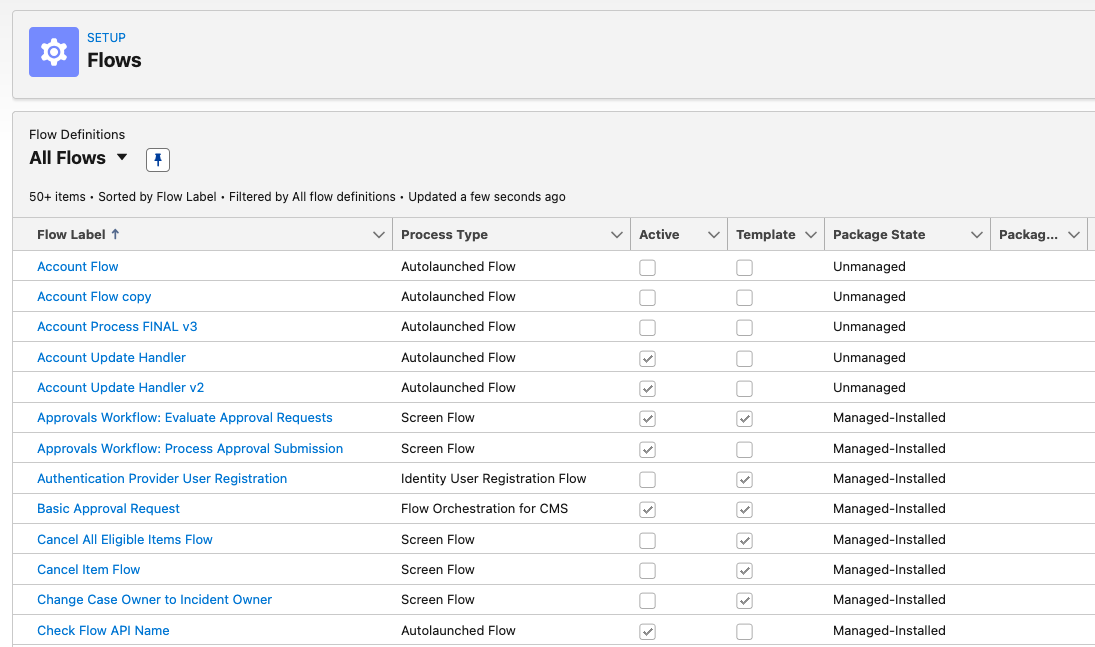
A practical rule: keep what encodes real business decisions, rebuild what encodes deadline shortcuts. A well-designed set of objects and relationships represents months of business alignment, even in a failed program. Ten overlapping flows firing on the same object represent a series of Friday-afternoon fixes. The first is an asset. The second is the failure.
Ask three questions of each area:
- Does it hold real business logic the organization agreed on, or is it an accident of who built it last?
- Is it a foundation other things depend on (data model, sharing, integration contracts), or a leaf feature you can replace cheaply?
- Would rebuilding it teach you anything you do not already know? If not, stabilize it and move on.
The honest failure mode here is sunk-cost salvage: keeping broken work because someone paid for it. When configuration actively fights the business (a sharing model that hides records people need, an object structure that cannot represent the actual process) rebuild it deliberately, scoped as its own baseline. The test is future cost, not past spend.
How to choose the second partner differently
The second partner has to be chosen against the reason the first one failed, not on price or logo. If the first engagement failed because admin-level configuration was sold as architecture, the fix is not a cheaper admin. It is design authority: someone senior enough to challenge a bad requirement and own the data model across the whole program.
That is the case for architect-led delivery. Tucario runs an architect on every engagement, and our practice is led by a Salesforce Certified Technical Architect (one of fewer than 500 worldwide). Across 50+ enterprise engagements, the pattern in rescues is consistent: the failure was rarely a coding gap. It was the absence of anyone with the standing to say “this requirement will cause the problem you are describing” before the build started.
Questions worth asking a prospective second partner:
- Who owns the data model and the architectural decisions, by name and by role?
- Will you give me an independent findings document before you propose a build?
- What will you tell me to not do? A partner who only says yes is how you got here.
- Who challenges the business when a requirement is wrong?
If a fractional or advisory model fits better than a full rebuild team, that can be the right shape too. See the companion pieces on scoping an architecture review and on fractional Salesforce architecture for that decision.
When you don’t need a full rescue
Not every struggling org needs a rescue. If your data model is sound and the complaint is really adoption or reporting, you have a change-management and data-quality problem, not an architecture one, and a lighter engagement fixes it. If a single team is unhappy but the platform serves everyone else, scope the fix to that team rather than reopening the whole build.
The signal that you do need independent help: reports nobody trusts, a release process nobody follows, and a build no one on the current team can fully explain. When three of those are true at once, get an outside read before you spend another quarter. Technical debt that accumulated quietly is worth its own diagnosis.
An independent Architecture Review is the low-commitment first move: a ranked findings document and a sequenced fix plan, without signing up for a rebuild you may not need. It tells you which of the five failure causes you actually have, which is the one decision that determines everything after it.
Frequently asked questions
Can a failed Salesforce implementation be recovered?
Yes, in most cases. The majority of “failed” orgs are stalled rather than broken: over-configured, under-governed, and missing design authority. An independent assessment usually finds a salvageable data model and integrations, with the damage concentrated in the automation layer. Recovery means re-sequencing and stabilizing, not rebuilding everything from scratch.
Should we rebuild our Salesforce org from scratch?
Rarely. Rebuilding discards working configuration and restarts user adoption from zero. Salvage what encodes real business decisions (data model, sharing, integrations) and rebuild only what encodes deadline shortcuts, scoped as its own baseline. Decide by future cost, not past spend. Rebuild deliberately where configuration actively fights the business.
How do we choose a second Salesforce partner after one failed?
Choose against the reason the first partner failed, not on price. If admin work was sold as architecture, you need design authority: someone senior enough to challenge bad requirements and own the data model. Ask who owns architectural decisions by name, and what they will tell you not to build.
How long does a Salesforce rescue take?
It depends on the failure cause and org size, so treat any range as indicative and scope-dependent. The independent assessment is fast; stabilizing the foundation and rebuilding user trust take longer. A narrow working baseline that restores credibility with one team usually comes before broader remediation.
What is the first step in a Salesforce rescue?
Stop new feature development and net-new configuration. You cannot assess a moving target, and adding surface area to a system you do not yet understand makes the diagnosis harder. Freeze the build, keep critical fixes and security running, then commission an independent architecture review before deciding anything else.

Michał Bajdek
Co-Founder, Tucario
Co-founder of Tucario, a Salesforce consulting and product engineering firm. Works across enterprise Salesforce delivery — architecture, integrations and AppExchange products — and writes about what holds up in production.